Shipping costs
Shipping costs depend on the destination, shipping method and size of your order. The full overview also covers pallets, solar panels and other destinations.
View shipping costs and destinations
If only an estimate or no shipping price is shown for your order, please request a binding shipping quote through Technical advice before ordering.
my-PV AC ELWA 2
Maximizing solar energy for hot water and self-consumption
The AC ELWA 2 is a continuously adjustable hot water heating device with an output of 0 to 3.5 kW for grid-connected photovoltaic systems, and is the successor to the AC ELWA-E. It optimizes the self-consumption of your existing PV system by using surplus photovoltaic energy for hot water production. This increases your independence and avoids unpredictable or rising operating costs. Feed-in of PV energy to the grid is continuously regulated down to zero.
The AC ELWA 2 also offers an optional emergency hot water supply: if there is not enough sunlight, hot water can be brought to the desired temperature using energy from the public grid. The device can be installed in hot water tanks and buffer storage tanks.
Advantages compared to AC ELWA-E
- More power: 3.5 kW instead of 3.0 kW
- External temperature sensor included
- Easy installation: the heating element and control unit can be fitted one after the other.
- Simple operation with a display, as on the AC•THOR
- Multiple communication options: alongside Ethernet RJ45, there is also WiFi, RS485, PWM input and a potential-free relay output
- Connection of an additional external 3 kW heating element is possible
- Compact design
- Fixed wiring, no cable with a Schuko plug
- Easy upgrade path from AC ELWA-E to AC ELWA 2
AC ELWA 2 combined with the my-PV WiFi Meter
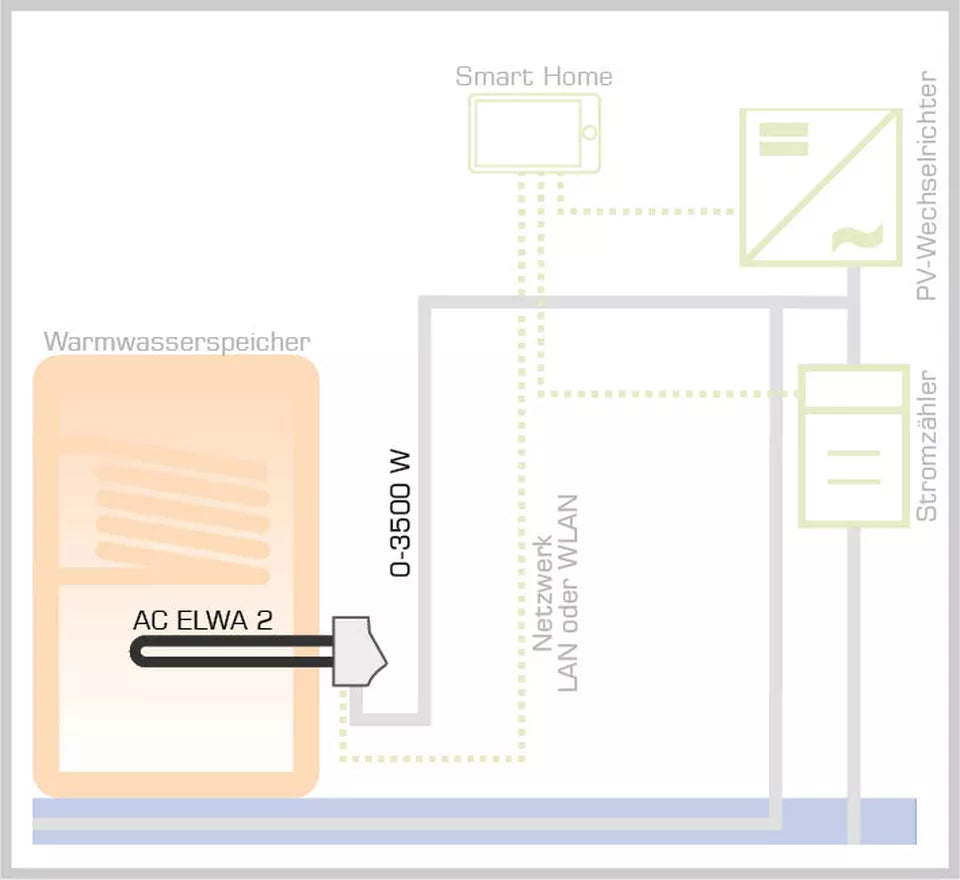
Combined with the my-PV WiFi Meter, the AC ELWA 2 uses exclusively surplus energy from your photovoltaic system. The heating output of the heating element is continuously regulated to minimize energy fed back into the grid and to maximize your self-consumption. The connection to the router can be made via a patch cable or wirelessly via WiFi.
AC ELWA 2 combined with battery storage
The AC ELWA 2 is compatible with many common battery storage systems. In this configuration, the battery storage is always charged first. Once the battery is full, the AC ELWA 2 takes over storing surplus photovoltaic energy in the form of hot water. Water is the most cost-effective storage medium and combines perfectly with chemical storage batteries. This way, the electricity you generate stays with you and is not fed into the grid.
AC ELWA 2 combined with smart home systems
Thanks to its open system control, the AC ELWA 2 also communicates with common smart home and energy management systems. Control is then handled by the smart home system, enabling complex control with settings for consumer priority. In residential buildings, this allows systems with multiple devices to work together, enabling remote monitoring and cost allocation at the individual apartment level.
PV-Wissen direkt in Ihr Postfach!
PV-Wissen direkt in Ihr Postfach!